Many businesses implement ERPNext with the help of a partner: a firm or independent consultant who configures the system, migrates data, trains users and provides support. A good partner brings experience you would otherwise have to build from scratch. But the partnership works only if both sides know what they are responsible for. This guide covers choosing a partner and working with one well.
What a partner should bring
- Functional knowledge. Understanding of accounting, stock, buying, selling and the other modules you need, in the context of real businesses like yours.
- A method. A clear sequence of phases with defined outputs, rather than "we will set it up and see".
- Local knowledge. Familiarity with your tax rules, statutory reporting and common business practices.
- Technical ability. Enough to handle hosting, backups, upgrades and any agreed development, or a clear arrangement with someone who does.
- Support after go-live. Defined response times and a way to log and track issues.
Questions to ask before you sign
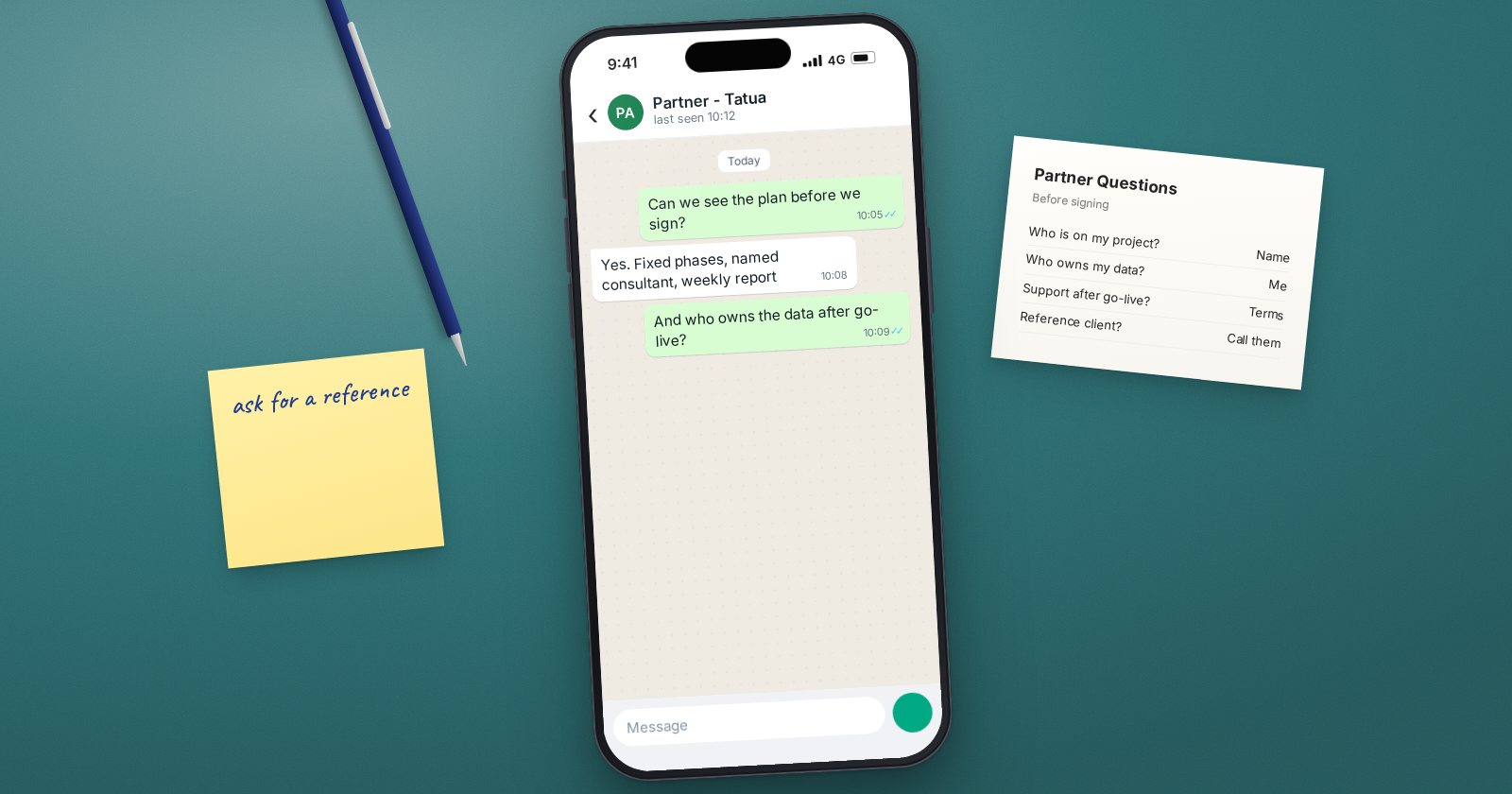
- Can you show how you run a project, phase by phase, with sample outputs such as a scope document or test log?
- Who will actually work on our project, and how much of their time is committed?
- How do you handle requests that are not in the scope?
- How do you decide between configuration and custom development?
- Who owns any custom code you write, and where will it be kept?
- How do you handle upgrades, and what happens to customisations during an upgrade?
- What do you need from our team, and how many hours per week?
- What does support look like after go-live, and how is it priced?
- Can we speak to a business you have implemented for?
Listen for specific answers. A partner who cannot describe their own method clearly will struggle to run your project clearly.
What to agree in writing
- Scope, including what is out of scope
- Phases, milestones and what each payment is tied to
- Responsibilities on both sides, including data preparation and sign-offs
- The change request process
- Ownership of data, configuration and any custom code
- Access arrangements: who holds administrator access and server credentials
- Support terms after go-live
- How the relationship can end, and what is handed over if it does
Ownership deserves special attention. Your business should hold administrator access to its own system and be able to get its data and code if it changes partner.
What your team must still own
A partner cannot implement ERPNext for you without your people. Your side must provide:
- A sponsor who makes decisions and removes obstacles
- Process owners who describe how work is done and sign off designs and tests
- Clean data, prepared and checked by the people who know it
- Time for workshops, training and UAT, protected from daily work where possible
- An internal system owner who will look after ERPNext after the partner steps back
When projects slip, the cause is often on the client side: late data, absent decision-makers or users who cannot be released for training. Plan for this honestly.
Working well together
- Hold a short weekly status meeting with an action list
- Keep one shared issue and decision log
- Raise concerns early; small disagreements grow if left
- Review each phase's outputs before paying for the next milestone
- Ask the partner to explain decisions, not just implement them, so your team learns
Checklist
- Partner's method and team confirmed
- Scope, milestones and responsibilities in writing
- Change request process agreed
- Ownership and access arrangements clear
- Sponsor, process owners and internal system owner named
- Weekly status and shared log in place
Understanding the implementation process yourself makes you a far better client. The ERPNext Implementation Consultant course is useful for internal project leads as well as consultants.