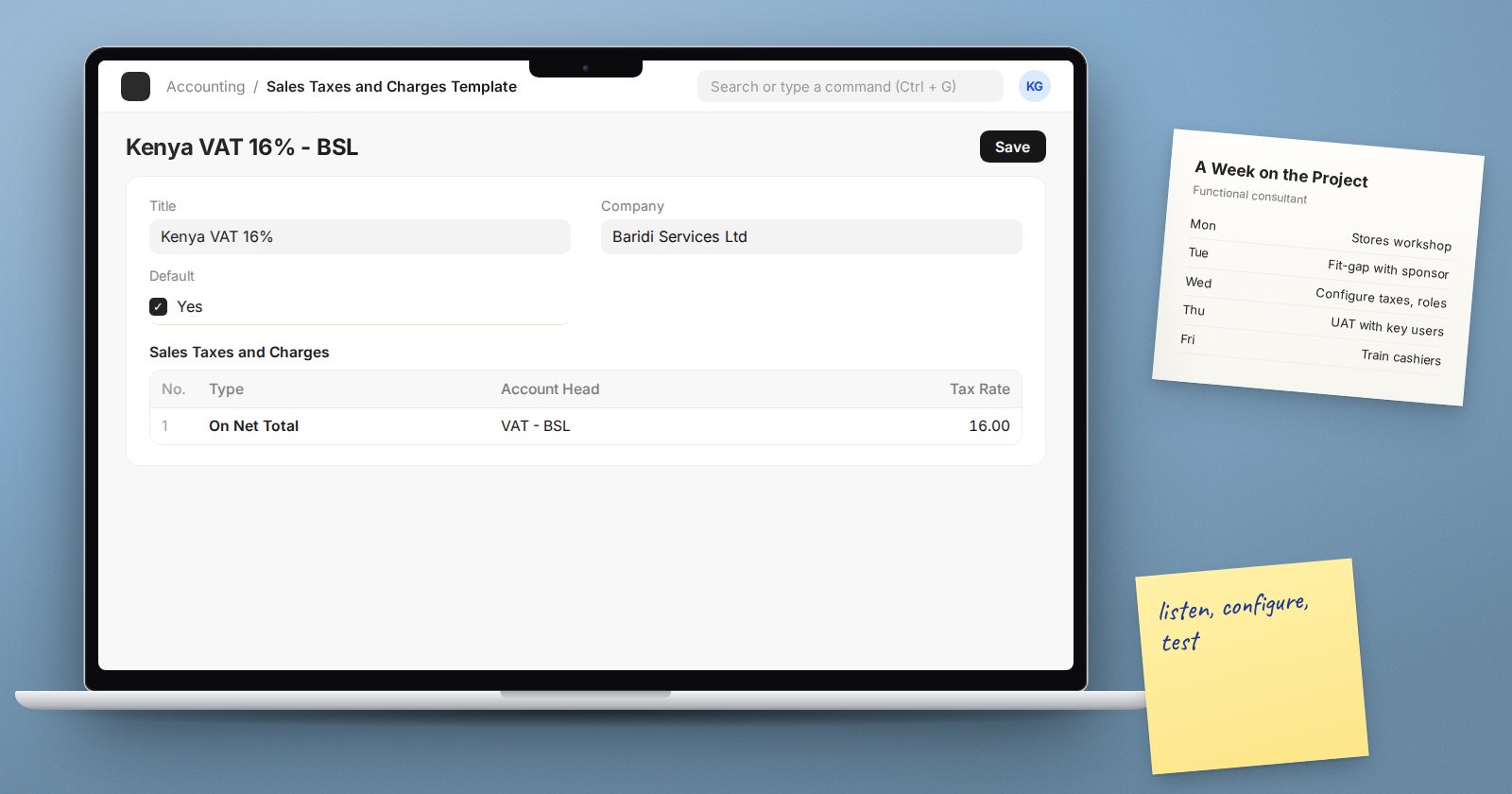
"Functional consultant" is a job title you see often in ERPNext work, but it is not always clear what it involves. In short, a functional consultant stands between the business and the system. They understand how a company works, understand what ERPNext can do, and design and deliver the fit between the two. They work mostly through configuration, data and people rather than code.
The core of the role
A functional consultant answers one question again and again: "How should this business do this in ERPNext?" To answer it well, they need to understand both sides. That means knowing why a business records stock receipts before purchase invoices, and also knowing which ERPNext documents, settings and reports support that.
What the work looks like across a project
Discovery and requirements
- Run workshops with owners and staff
- Map current processes and pain points
- Write requirements that can be tested
Design
- Match requirements to standard features, configuration, light customisation or development
- Recommend process changes where the standard way is better
- Write a solution design and get it signed off
Configuration
- Set up companies, the chart of accounts, warehouses, item groups, taxes, price lists and naming series
- Create roles, Role Profiles and permissions
- Build workflows, notifications and print formats
- Brief developers on anything that needs code
Data
- Design templates, guide the client in cleaning data and run imports with Data Import
- Plan and reconcile opening balances
Training and testing
- Write role guides and train users
- Prepare UAT scenarios and support users through testing
Go-live and support
- Run cutover, support users in hypercare and handle issues afterwards
- Help with month-end and year-end questions
How it differs from related roles
- Developer. Writes code: custom apps, integrations, complex reports. A functional consultant specifies what is needed; the developer builds it.
- System administrator. Keeps the system running day to day: users, permissions, backups and updates. There is overlap with a functional consultant, but the focus is operations, not design.
- Project manager. Manages scope, schedule, budget and people. On small projects the functional consultant often does this too.
Many people in this field move between these roles over time. A consultant with some technical skill, or a developer with strong business knowledge, is especially useful.
Skills the role calls for
- Business process knowledge. Accounting is the most important, because almost everything in ERPNext ends up in the ledger. Stock, buying and selling come next.
- ERPNext functional knowledge. Knowing how documents link, what each setting does and which reports show what.
- Communication. Explaining system concepts in plain language and listening well in workshops.
- Documentation. Clear process maps, designs, test scripts and guides.
- Problem solving. Tracing a wrong figure back to its source document.
- Basic technical comfort. Data imports, report filters, print formats and permissions, even if you never write code.
Is it a good fit for you?
People come into this role from accounting, stores, procurement, sales operations, audit and IT support. What they share is curiosity about how businesses work, patience with detail and a willingness to stand in front of a room and explain things clearly.
If that sounds like you, the ERPNext Functional Consultant learning path on UPEO Academy sets out an ordered route through the courses that build these skills.
Checklist of core abilities
- Run a requirements workshop
- Map a process into ERPNext documents
- Configure a company from the setup wizard onwards
- Design roles and permissions
- Import and reconcile data
- Train users and run UAT
- Support a go-live and first month-end