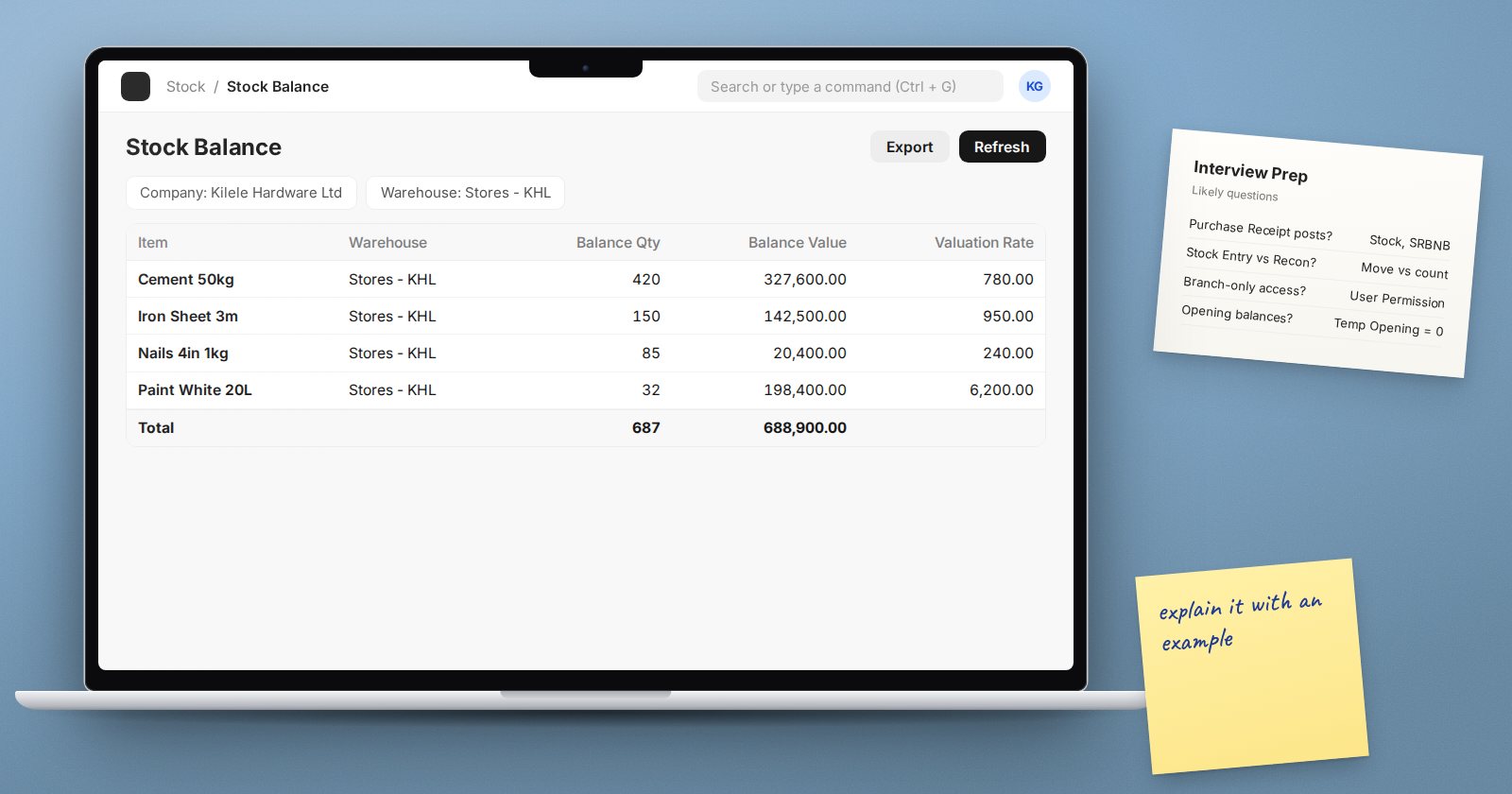
Interviews for ERPNext roles, whether functional consultant, support analyst or internal system administrator, tend to test two things: do you understand how businesses work, and can you make ERPNext do it correctly? Memorising menu paths will not get you far. Being able to explain why the system behaves as it does will.
Here is how to prepare, with sample questions to practise. Employers vary, so treat these as practice material, not a script.
Know the employer's world first
Find out what the business or partner does. A distributor will care about stock, pricing and receivables. A manufacturer will ask about bills of materials and costing. A partner will want to know how you handle clients. Prepare examples that fit their world.
Topics that come up often
Accounting flow
Most ERPNext problems end up in the ledger, so expect questions here.
- "What does a Purchase Receipt post when perpetual inventory is enabled?" Stock in hand is debited and Stock Received But Not Billed is credited. The Purchase Invoice later clears that account against the supplier.
- "A customer's balance in Accounts Receivable looks wrong. Where do you start?" Talk through checking the General Ledger for that party, unallocated payments, credit notes and invoices against the wrong customer.
- "How would you load opening balances?" Explain open invoices through the Opening Invoice Creation Tool, opening stock through Stock Reconciliation, remaining balances by opening journal entry, and the Temporary Opening account as the check.
Stock
- "What is the difference between a Stock Entry and a Stock Reconciliation?" A Stock Entry records a movement for a purpose such as Material Receipt, Material Issue or Material Transfer. A Stock Reconciliation sets quantity and value to a counted figure.
- "Stock value in the accounts does not match the stock report. Why might that be?" Mention postings made directly to stock accounts by journal, and back-dated entries.
Users and permissions
- "How would you stop a branch user from seeing another branch's documents?" Explain roles for what they can do and User Permissions for which records they can see, such as a particular branch, warehouse or company.
Implementation judgment
- "A client wants ten new mandatory fields on the sales invoice. What do you do?" Show you would ask why, look for standard options, and consider process change before customising.
- "How do you migrate customers and items?" Describe cleaning first, using Data Import templates, loading in dependency order and test loading on a copy.
- "Describe a go-live you would be uncomfortable approving." Show you know what readiness looks like: signed UAT, reconciled data, trained users.
Expect a practical test
Many employers ask candidates to do something in a live system, such as create an item, run a purchase cycle and explain the ledger entries, or fix a deliberately broken setup. Practise doing tasks while talking through your reasoning out loud. That is exactly what they want to see.
Talk about your experience honestly
Use specific examples: what the situation was, what you did and what happened. If your experience comes from a practice company, say so and walk them through it. Interviewers usually respect honest, well-explained practice work more than vague claims about large projects.
If you do not know an answer, say how you would find out: checking the document's settings, reading the General Ledger, testing on a copy. That shows the habits of a good consultant.
Questions to ask them
- How are projects run, and who will I work with?
- What does a typical week look like in this role?
- How do you handle support after go-live?
- What would success look like in my first three months?
Checklist
- Researched the employer's industry and likely modules
- Practised explaining the accounting impact of common documents
- Reviewed stock movement types and reconciliation
- Can explain roles versus User Permissions
- Prepared two or three real or practice examples
- Practised a live task while explaining your reasoning
- Prepared your own questions
The Accounting Essentials and Inventory Essentials courses cover much of the ground these interviews test.